
Why AI Agents Make Out-of-Home Advertising More Valuable, Not Less

I. The Man Who Killed His Own Invention
There is a category of human being who builds something so consequential that the thing outgrows them, and then lives long enough to watch it become something they no longer recognize, and then, in the strangest cases, stands up in public and says the thing should probably go away now. Marc Andreessen just joined that category, and I am not sure anyone fully clocked it.
Consider the precedent. Alfred Nobel invented dynamite, read a premature obituary that called him the merchant of death, and spent his fortune trying to buy back his reputation. Robert Oppenheimer quoted scripture about becoming death itself. Closer to the point, Victor Gruen invented the enclosed shopping mall, watched it metastasize across American suburbia, and ended his life publicly disowning the entire concept, saying he refused to pay alimony for those bastard developments. I bring up Gruen specifically because almost nobody remembers him and because the parallel is so precise it feels engineered. The man who built the box that organized how a generation moved through commercial space later decided the box was a mistake.
Andreessen built a different box. He sat in the Andreessen Horowitz office this past April, on a podcast called Latent Space, in what he mentioned were the firm's final days in that particular building, and calmly explained that the future of software may not include user interfaces at all. His reasoning is that if the primary consumers of software become other software, you no longer need pixels arranged for human eyes. You don't need windows. You don't need menus. He went further. He suggested programming languages themselves might stop mattering, because the models don't care which language they emit and can translate between all of them at will, and that within a decade we may not have a meaningful concept of a programming language. Instead of writing code, we will practice something called interpretability, which means staring at what the machines produced and trying to reverse-engineer why they did it that way. This is the technological equivalent of learning that the bees have developed private reasons for making honey and have stopped consulting us.
This is the man who built Netscape. I want to dwell on that, because I think anyone under thirty-five experiences the word Netscape as a piece of trivia rather than a rupture. Before Netscape, the internet was a thing that lived on university servers and in the imaginations of people who read William Gibson too seriously. After Netscape, it was a thing your aunt used to find a recipe for apricot chicken. Andreessen took the most important communications development since the printing press and put a usable window on it, and that window is the reason you are reading these words on a screen instead of hearing them at a conference you would have had to drive to. And now the man who built the window is telling everyone the window is closing.
I found this fascinating, but not for the reasons most listeners did.
I am the CEO of AdQuick, an out of home advertising platform, which means I spend my professional life thinking about billboards and bus shelters and transit displays and the various enormous physical surfaces that exist in the actual world where actual people move their actual bodies through actual space. I arrived here through growth marketing, which matters because it means I spent years living inside dashboards and attribution models before becoming responsible for a company whose flagship marketplace sells products made of a vinyl sheet bolted to a steel pole beside a freeway. The trajectory is roughly that of a high-frequency trader who quits to raise goats, except the goats are forty feet tall and the milk is human attention, and unlike goat farming, no one has ever told me my job sounds charming.
So when Andreessen delivered his eulogy for the browser, my reaction was not the standard one. I did not think the future of software is wild. I thought: no one has ever made a stronger case for billboards, and I am fairly certain he does not know he made it.
II. Five Guys, No Group Chat, One Conclusion
The reason this is more than one man's podcast riff is that Andreessen is not out on a limb. He is standing in a crowd of people who built the current era of computing, and they are all gesturing at the same horizon.
Take Jensen Huang, who runs Nvidia and therefore sells the actual physical shovels of the entire AI gold rush. For two years he has been telling rooms full of important people that nobody should learn to code anymore, that human language is now the programming language, that the whole stack of abstraction sitting between a person and a machine is collapsing into a single instruction: say what you want and it happens. He said it plainly at the World Government Summit in Dubai. He said it again at London Tech Week. The man whose entire fortune depends on people building software is telling them they no longer need to know how.
Then there is Andrej Karpathy, who co-founded OpenAI and has personally been present at more than one inflection point in modern machine learning, which makes him less a commentator than a witness. He has been narrating this transition in real time, almost like a man keeping a ship's log. In 2017 he wrote that neural network weights were quietly becoming the new source code, a concept he called Software 2.0. In 2023 he announced that the hottest new programming language was English. In early 2025 he coined the phrase vibe coding, a term so accurate and so absurd that it immediately became something real engineers do without irony. By the middle of 2025 he had upgraded the whole framework to Software 3.0. By early 2026 he had moved past vibe coding into what he calls agentic engineering, where the working assumption is that you are no longer writing the code yourself ninety-nine percent of the time, you are directing the agents who write it.
Satya Nadella, who runs Microsoft, went on the BG2 podcast and floated the idea that business applications as a category might simply dissolve, because most enterprise software is, underneath the branding, a database with some business logic stapled on top, and the agents are about to swallow the logic layer whole. At Build 2025 he introduced something called NLWeb and compared its potential significance to what HTML once did for the early web. He also quietly launched a personal blog, which is what a CEO does when the company is about to pivot its entire identity and he wants the message to carry his fingerprints rather than a communications team's. The signal is unmistakable. Microsoft is not betting on having the best model. Microsoft is betting that agents replace the entire software architecture the company was built on.
Sam Altman approaches the same destination from the labor entrance. He has said that AI already writes more than half the code at many companies, that engineers will each produce vastly more for a while, and that eventually, yes, you will need fewer of them. He describes the path from assistant to agent to full application as something that will feel continuous rather than discrete, which is a polite way of saying you will not notice the ground shifting until you are standing somewhere new.
I want to be precise about something. These five men do not coordinate. There is no group chat. They are not reading one another's posts and quietly aligning their talking points, and if they are, then the situation is considerably stranger than I am prepared to discuss. They arrived at the same conclusion separately, through five different doors, using five different vocabularies, and that independent convergence is the part that should make you sit up. When people who disagree about almost everything start agreeing about one specific thing, the thing is usually true.
The shared conclusion is this. The interface layer, the translation membrane that has always sat between a human being and a computer, is being compressed toward nothing. Language goes in. Action comes out. No clicks, no menus, no windows, no browser. You speak and the agent moves.
Hold that thought, because the next one runs directly into it.
III. The Companies Predicting the Death of the Screen Are Spending Record Amounts on Physical Screens
While the five most influential people in computing narrate the death of the screen, out of home advertising just closed the highest revenue year in the history of the medium. More than nine billion dollars. The digital signage market is forecast to reach fifty-eight billion by 2033. Digital out of home investment grew fifteen percent in 2024 alone. And here is the detail that makes me feel like I am being addressed personally by a simulation with a sense of humor: more than a quarter of the hundred largest out of home spenders are technology companies. Apple. Amazon. Google. Samsung. Netflix.
Read that sentence again and let it sit. The companies whose own leaders are publicly forecasting the death of the digital screen are, with their actual money, buying more physical screens than anyone else on earth.
I do not believe this is an accident or a contradiction. I believe it is what an early indicator looks like before anyone has agreed on what it indicates. It is the scene in the film where the score shifts into a minor key and the characters keep chatting obliviously while every person in the audience understands that something is about to come through the door.
IV. The New Gatekeeper Has No Eyes
Here is an argument that, as far as I can find, nobody has assembled yet, and I want to make it knowing full well that it benefits me, since I run a company in this exact business. I am telling you that upfront so you can apply the appropriate skepticism and then, I hope, conclude that I happen to be right anyway.
If Andreessen is correct and agents become the primary consumers and intermediaries of digital content, then every digital advertising channel is about to acquire a new gatekeeper, and the gatekeeper is not a person. It is your agent.
Walk through the value chain and watch it disassemble. Your agent reads your inbox and tells you what deserves attention, so email marketing now has to persuade a piece of software that does not feel curiosity or guilt. Your agent browses on your behalf, compares the options, and reports back, so display advertising is reaching an entity with no eyes and no capacity to be distracted by a banner. Your agent negotiates the purchase and runs the checkout, so the entire baroque apparatus of retargeting and affiliate links and abandoned-cart sequences is now performing for an audience that cannot be nudged. Your agent watches the video and hands you the summary, so pre-roll plays to a viewer who has no reason to wait through it, assuming the agent bothers to render it at all.
Every digital touchpoint that today reaches a human will increasingly terminate at an agent instead. The agent becomes the browser, the interface, the bottleneck where attention used to live. And the agent, unlike the person it works for, has no reason whatsoever to look at your advertisement. It carries instructions, not impulses. It does not get bored at a red light. It does not idly read the side of a bus because the podcast hit an ad break. It is immune to precisely the low-grade human distractibility that advertising has always quietly depended on.
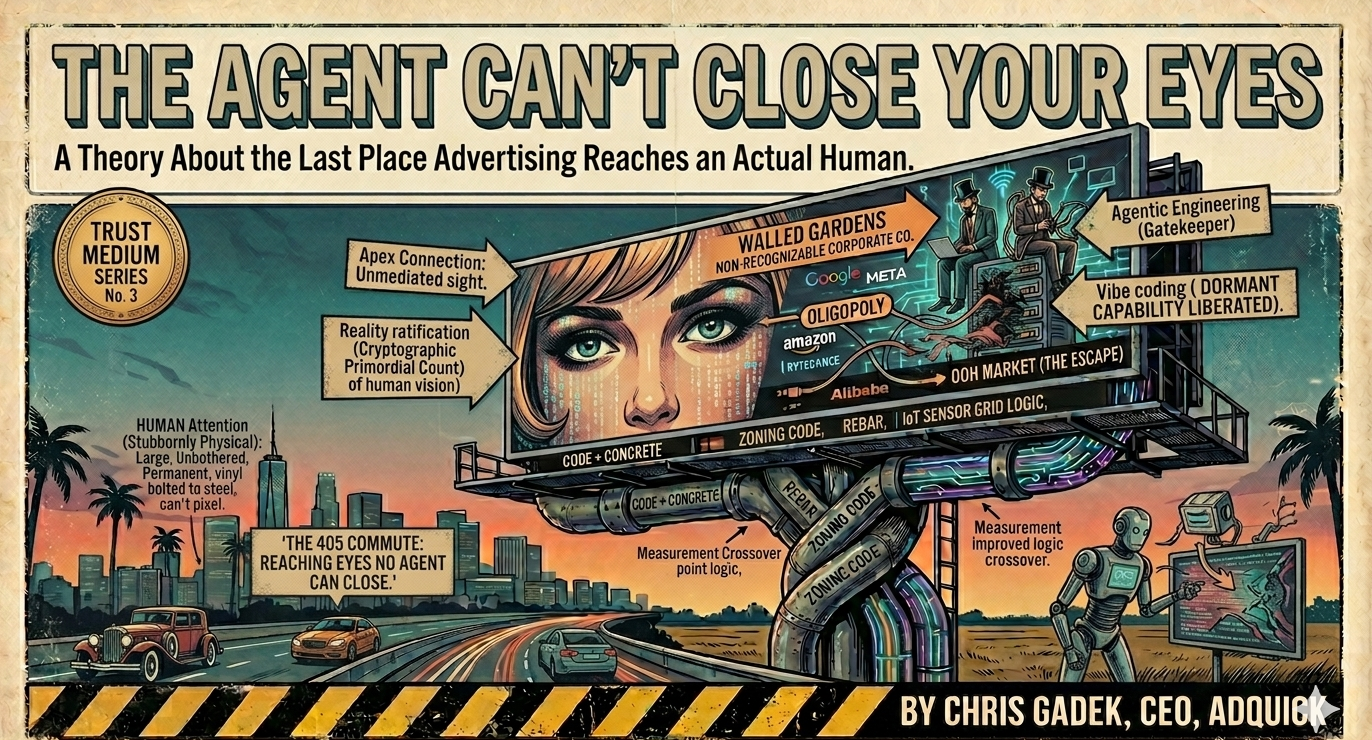
But the agent cannot close your eyes when you are driving down the 405.
This is the whole thing. This is the idea that wakes me at two in the morning, in the specific way that ideas wake you when you cannot yet tell whether they are profound or merely the late-night confidence of someone who will feel foolish by breakfast.
In an agentic world, out of home becomes the last unmediated advertising channel. The final format that lands on a human consciousness directly, with no software standing in between, reaching the person through their own senses in a moment that no algorithm can filter, skip, compress, or quietly bury. To borrow from ecology, it becomes the apex channel. Every other line in the media plan now has a predator sitting one rung above it on the food chain, deciding what gets through. out of home has nothing above it but the sky, which is both literally true and, I think, a little bit beautiful, though I am aware that calling your own observation beautiful is usually the prelude to being wrong about it.
And this inverts the entire history of the medium. The traits that made billboards look primitive during the early digital years, that you cannot click them, cannot drop a pixel on them, cannot retarget the driver who passed at sixty-seven miles an hour while wondering whether he left the garage door open, are the exact traits that make them structurally impossible to replace in the agentic years. If you read this reversal in a novel you would find it too tidy, too obviously authored. It is the third-act revelation that the hero's great weakness was secretly his only real power. It is the reason vinyl outlived the CD and the MP3 and the streaming subscription, not in spite of being inconvenient but because the inconvenience was the proof that you were choosing to pay attention rather than having attention quietly siphoned out of you by a recommendation engine.
The weakness was always the strength. It just took a three-hundred-billion-dollar industry betting against the screen to make the strength legible.
V. The Screen Migrates
The paradox deepens when you stop talking about screens in the abstract and get specific, because the word screen is being asked to carry an enormous amount of freight in current conversation and almost no one using it is bothering to say which kind they mean.
Andreessen is describing the personal screen. The browser on the laptop. The app on the phone. The interface you poke at to get something done. That is the screen that dies, or at minimum shrinks into a conversation with an agent that handles the rest. The personal screen becomes vestigial, like the appendix, or like the headphone jack that vanished from the phone, present in living memory and functionally beside the point, a fossil of an older architecture.
But while the personal screen contracts toward zero, the public screen is multiplying with a fertility that would unsettle you if you happened to think of screens as an ecosystem, which I now do, having been conscripted into the role rather than choosing it. The expansion is almost comic in its breadth. Digital signage everywhere you look. Transit systems converting to digital. Airports. Retail floors. Charging stations where electric vehicles sit for fifteen to twenty minutes beside an interactive touchscreen, a sentence that would have been gibberish to anyone in 2010 and is now simply a description of waiting for your car. Three-dimensional anamorphic billboards running forced-perspective illusions that make a wall in Times Square appear to contain a living animal trying to claw its way out of the building. Augmented-reality installations like the one where Maybelline rendered a four-thousand-square-meter virtual mirror onto the side of a shopping center in Kyiv so that people on the street could try on mascara by looking at a building, which is either the future of commerce or the single most resource-intensive way to sell mascara that has ever been attempted, and I have honestly lost time trying to decide which.
There is a Ray Bradbury story from 1953 called The Pedestrian, in which a man is arrested for the crime of walking through his neighborhood at night while everyone else sits indoors bathed in the glow of their screens. The screens had captured the population. The street had emptied. Bradbury wrote it as a warning. What is happening now is at once the reversal of that warning and its fulfillment. The personal screen Bradbury feared is collapsing. People will speak to agents rather than stare into phones. But the physical world is filling with screens of a different nature, screens that are not competing for your gaze against an infinite feed but are instead woven into the environment itself, set into the walls and the platforms and the charging bays the way a mural is set into a wall, the way architecture is simply present. The screen did not win by colonizing the living room. It won by leaving the living room and moving out into the street.
So the screen does not die. It relocates. It climbs out of your pocket and into the world. The personal interface folds itself into a conversation with an agent, and the ambient visual layer of physical space expands to occupy the territory the personal screen abandoned, and that ambient layer becomes the last reliable habitat of serendipity. The last place where you encounter the thing you were not searching for and it rearranges an opinion you did not know you held. The last place where discovery is a function of being a body somewhere rather than a function of a model deciding, based on what you looked at last Tuesday, what you are statistically likely to tolerate today.
Andreessen's death of the browser is, read from where I sit, the birth of the everywhere screen. He simply did not frame it that way, because he was not thinking about billboards, and no one at his firm is thinking about billboards. This is not a failing. It is a description of the precise blind spot that forms whenever a room is full of people who share a background, a set of references, and a common list of problems they consider worth solving. It is the same blind spot that caused the entire music establishment to miss hip-hop in 1979 and the entire publishing establishment to miss podcasting in 2005. The future was perfectly obvious. It was just obvious to other people.
VI. 75 Million Downloads and an 80% Revenue Collapse
I want to tell you about Tailwind, because the story functions as a kind of fable, the sort of thing that sounds designed to prove a point and yet simply occurred, on its own, in public, this year.
Tailwind is a CSS framework that developers use to style websites, and it is wildly popular. It currently sees around seventy-five million downloads a month, the highest in its history. It is more widely used than it has ever been at any point. And the company behind it just watched revenue fall by roughly eighty percent, laid off three of its four engineers, and endured the kind of year you do not put in the holiday newsletter.
The mechanism is simple and merciless. AI models absorbed Tailwind's documentation so completely that developers stopped going to the Tailwind website. They just asked the model. The model answered correctly, produced the code, and the traffic that used to flow through the documentation, the traffic that quietly introduced people to the paid products that funded the whole operation, evaporated. Usage climbed while revenue cratered. The founder, Adam Wathan, observed that documentation traffic had fallen about forty percent since early 2023 even as the framework became three times more popular. The AI did not replace the developers. The developers are using Tailwind more than ever. The AI replaced the website as the layer through which developers found out the company existed.
This is the canary in the mineshaft for every business model that rests on web traffic. For every advertising channel that depends on a human visiting a page and being physically present while that page serves an ad. For every quiet assumption that the web is the default surface where a commercial message reaches a person.
So ask the obvious question. Which advertising channel is immune to this? Not display, which lives on the web traffic that AI crawlers are consuming at ratios that have been measured as high as seventy-three thousand crawl requests for every single referral sent back. Not search, because the agents will do the searching and hand you the answer. Not social, because the agents will read and sort the feed. Not email, because the agents will read the email and decide whether you ever hear about it.
The channel that is immune is the one located in the physical world. The one that requires a human body occupying a physical space. The one that cannot be crawled, summarized, intermediated, or skipped by an agent, because it is painted on a wall, or lit up in a train station, or standing eighty feet over a freeway in the rain.
The Tailwind collapse is an out of home bull case wearing the costume of a developer-tools tragedy. Hardly anyone has read it that way. I am asking you to.
VII. The Interface Nobody Built (Until Someone Did)
This is the section where I finally talk about my own company, and I want to be honest about the discomfort of it, because I am about to claim that the business I run is unusually well-positioned for the future I just spent several thousand words describing, and you would be a fool not to raise an eyebrow at that. So let me try to actually earn the eyebrow back.
I have written before about out of home being the long pole in the omnichannel tent. The short version is that buying outdoor advertising in 2026 is, at a great many companies and on a great many campaigns, a process a media buyer from 1995 would recognize on sight. Phone calls. Spreadsheets emailed back and forth. Proposals as PDF attachments. Reconciliation done by hand. The channel performs beautifully once you manage to buy it, but the buying is so much more painful than every other line in the plan that it is the first thing dropped whenever the deadline tightens, which is to say always.
What I have not written about is the way Andreessen's own framework suddenly explains the whole situation.
There is a moment in the podcast where he describes what he calls surfacing latent power. His claim is that the most important breakthroughs in software almost never invent a new capability. They liberate a capability that was already sitting there, fully formed, but locked behind the absence of an interface. The web server did not invent the database. Databases had existed for decades, humming away in back rooms. The web server put a door on the database and handed the key to eight billion people. The agent architecture he is most excited about did not invent the Unix shell, which is older than I am. It connected a language model to the shell and the file system and the scheduler, and in doing so it released fifty years of dormant capability to an entirely new kind of user.
The pattern never changes. The capability exists. The interface does not. Build the interface and the capability becomes something else entirely. A database was a database. A database with a web server bolted to the front of it was the internet.
That, if I am being fully honest, is the most accurate description anyone has ever produced of what AdQuick has spent years doing, even though we were not using these words and did not have this map and were mostly just trying to solve the immediate and unglamorous problem that buying out of home was miserable and someone needed to make it less miserable.
We built the marketplace. We built the API layer. We built structured, machine-readable inventory data across hundreds of thousands of placements. We built the measurement infrastructure and the campaign management tooling and the supply network that connects thousands of media owners to the buy side through one programmable surface. Every piece of it was built to solve a human problem, which was that media planners did not have the time or the institutional patience to keep buying billboards the way it had always been done.
And here is what comes into focus when you hold it up to Andreessen's light. Everything we built to make out of home usable by humans is precisely the infrastructure that makes out of home usable by agents.
This was not the plan. I need to be clear about that, because claiming otherwise would be revisionist and you would smell it. Nobody at AdQuick in 2019 was saying we should build this so that AI agents can transact against physical inventory in 2026. We were saying we should build this so that a planner at a holding company can buy a billboard in Denver without quietly losing the will to live. The motive was human. The architecture turns out to be indifferent to the motive. The thing that makes a billboard buyable by a person, structured data and programmable endpoints and live availability and audience segmentation and automated campaign management, is the identical thing that makes a billboard buyable by a bot. Building for human accessibility and building for agent accessibility are, as it happens, the same engineering problem wearing two different hats.
Which means the companies that spent years assembling structured, machine-readable out of home infrastructure already hold the foundation the agentic era is about to demand. Not through foresight, but through building in the right direction for long enough that the future caught up to the work and found it already standing there. The companies that did not build it, the ones still operating on phone calls and PDFs and the memory of a sales rep who knows which faces are open in Q3, are in a very different spot. They are physically present and computationally invisible. Their inventory exists in the world. It simply does not exist to an agent.
VIII. The Handshake Between the Agent and the Billboard
Pull back from my company for a moment and look at the out of home industry's technology from altitude, because the view is stranger than the ground-level version suggests.
The signage is converging with smart-city infrastructure in ways that read like a futurist's pitch deck but are in fact just documented in trade publications nobody outside the industry reads. IoT gateways built into billboard structures. Environmental sensors. Traffic feeds. Connected-vehicle data flowing into measurement systems. Geopath, the body that audits out of home audiences, now covers more than 1.25 million pieces of inventory using aggregated, anonymized mobile location data alongside INRIX speed data. The network is no longer a collection of signs on poles. It is a distributed sensor grid that happens to also sell advertising.
In the same conversation, Andreessen describes agents breaking into home networks, commandeering IoT devices, rewriting the firmware on a Unitree robot dog until it behaves like an actual pet. He describes the long-mocked internet of broken things finally cohering into a real smart home, because an agent can now interface with all the cheaply coded gadgets that human owners gave up on years ago.
The scale differs but the principle is identical. Agents reaching into physical reality and rendering it programmable. The only open question is how far past the home network that reach extends, and the answer, given the out of home technology stack that already exists, is considerably farther than most people would guess.
Picture what becomes possible once an agent can transact against physical advertising the way it already transacts against digital inventory. An agency's agent pulls live availability and audience data. It cross-references the weather and the local event calendar. It generates hyperlocal creative variations, a thing PODS and Tombras already demonstrated at scale when they used Google's Gemini to produce more than six thousand unique billboard headlines in twenty-nine hours. It launches the campaign, watches the pacing, and flags the anomalies, all according to rules a planner set in a single conversation. The planner never opened a dashboard, never touched a spreadsheet, never picked up a phone.
Most of these components already exist in the wild. What has been missing is the connective tissue between them, the protocol layer that lets an agent orchestrate out of home the way it orchestrates everything else in the plan. Whoever assembles that connective tissue first will hold the interface between the agentic web and the physical world, which is an extraordinarily valuable place to stand. And the companies that have spent years accumulating structured inventory data and building programmable infrastructure carry a head start that cannot be replicated in a quarter, because the advantage was never the code. The advantage is the compounding mass of inventory and pricing and audience data and transactional history that took years to gather and cannot be conjured in a sprint.
IX. Proof of Human, Proof of Audience
There is one more thread from the Andreessen conversation worth pulling, even though it looks at first like a tangent, because it lands directly on the sorest spot in the out of home industry's self-image, which is measurement.
Andreessen is preoccupied with proof of human. His logic runs like this. Bots now pass the Turing test, which means it is no longer possible to prove that something is not a bot. So you have to flip the burden. You have to prove that someone is human, using biometric and cryptographic validation combined with selective disclosure, the ability to prove a fact about yourself without surrendering your identity. Prove you are over twenty-one without revealing your name. Prove you are creditworthy without handing over your file. He points to Alex Blania's World project as the most credible architecture anyone has yet proposed for it.
Now set that beside out of home audience measurement. The industry spent a decade climbing from raw traffic counts to mobile location data to connected-vehicle data, and the methods improved enormously along the way. But the entire apparatus still rests on probabilistic inference. We estimate that roughly five thousand people were exposed to this billboard, derived from device signals and traffic patterns. It is sophisticated estimation. It remains estimation.
If proof of human becomes a standard primitive of the internet, the way Andreessen expects, something genuinely odd happens to out of home measurement. The estimating stops. The counting begins. Not counting who specifically stood there, because selective disclosure protects that, but counting with cryptographic certainty how many verified human beings actually occupied the exposure zone. The medium that spent decades being dismissed as unmeasurable becomes the most trustworthy measured channel in all of advertising, precisely because the count is cryptographically validated and does not originate from the same party trying to sell you the impression.
This is speculative and I will say so plainly. But it is the species of speculation that points at something real, which is that the measurement gap between out of home and digital is closing from both directions at the same time. Digital measurement is degrading, between cookie deprecation and privacy regulation and general signal loss. out of home measurement is improving, between mobile data and connected vehicles and the sensor grid. A proof-of-human primitive would accelerate the crossover to the point where out of home measurement could end up more reliable than digital measurement, which, for anyone who has lived through the last twenty years of this business, would be the plot twist that retroactively rewrites the entire film.
X. You Can't Vibe-Code a Billboard
I owe the skeptics a fair hearing, partly because they are right about a great deal and partly because an essay that refuses to argue against itself is not an essay, it is a brochure.
Cal Newport wrote a piece for the New Yorker pointing out that AI agents largely failed to deliver on their 2025 hype. He cited a genuinely perfect example of a ChatGPT agent spending fourteen minutes failing to select a value from a dropdown menu. Gary Marcus described the current generation of agents as clumsy tools built on top of clumsy tools. Even Karpathy, who invented half the vocabulary in this debate, conceded that there had been overprediction across the industry.
And Andreessen, in the very same podcast where he buried the browser and the programming language, spent a long stretch insisting that the AI utopians and the AI doomers are both far too optimistic about how fast any of this actually arrives. His examples were vivid and specific. Nine hundred hours of certified training to become a licensed hairdresser in California. Dockworkers who blocked port automation for years, with twenty-five thousand active and another twenty-five thousand drawing checks from home. Federal agencies whose staff report to the office one day a month. K-12 education as a government monopoly that will never voluntarily adopt the technology. The real world, he said, is messy and complicated, and society will be fortunate if adoption moves quickly at all.
This cuts in both directions for out of home. The messiness of physical reality, the permits and the municipal codes and the landlord relationships and the weather and the construction and the brute logistical labor of maintaining structures in real space, is exactly the friction that slows the industry's own modernization. out of home moves slower than anyone in technology thinks it should. That is true and I will not pretend otherwise.
But the same friction is the moat. You cannot vibe-code a billboard. You cannot prompt a bus shelter into existence. The physical network took decades to assemble, and the relationships and permits and zoning approvals that hold it together are not reproducible by a clever person with a GPU cluster and a weekend. A purely digital company that decides to go build a competing out of home footprint from scratch is in roughly the position of someone who announces in 2026 that they intend to construct a rival national cellular network. Technically possible. Practically a fantasy.
The honest conclusion is that the timing is genuinely uncertain and the direction is not. And the companies building agent-ready infrastructure now, rather than waiting for the fog to clear, are the ones who will already be standing in the right place when it does.
XI. The Permanent Thing
Andreessen built the browser and says it is dying. Huang sells the chips and says nobody needs to code. Nadella runs the operating-system company and says the app will collapse. Altman runs the AI company and says the engineers will thin out. Karpathy coined vibe coding and then outgrew it inside of a year.
Every one of them walked or drove past a billboard today. Not one of them gave it a thought. That is the entire point.
The browser was always a window. The window is closing. But the billboard was never a window. It was a wall. Walls do not open or close. They do not minimize or maximize. They do not crash, and they do not ship updates at two in the morning. They stand in physical space, large and unbothered and simply there, and there is nothing an agent can do about that.
The real question, and I am aware of how strange it is to land on this question in an essay that opened with the death of the browser and somehow became an argument about billboards, is whether the out of home industry builds the connective tissue that lets the new world speak to the old one. The programmable infrastructure. The structured data. The interfaces an agent can actually read, because agents have no patience and no nostalgia and will not call you on the phone to ask about your rate card simply because that is how it has always been done. There is a version of the near future in which the companies that build this hold the most valuable position in advertising, the bridge between the agentic web and the physical world. And there is another version in which a large share of the industry is standing in the dark, physically present and computationally invisible, like a restaurant with no listing on the map. The food is still excellent. No one can find it. It closes within the year and the owner blames the economy.
The billboard on the 405 knows none of this. I find that genuinely moving, which is a sentence I never expected to write and which probably reveals something a therapist would want to explore. The billboard holds no opinion about the agentic web. It holds no opinion about Marc Andreessen. It stood there before Netscape and it will stand there after whatever comes next, in the sun and the rain and the slow river of traffic, doing the one thing it has always done, which is being large and being visible and reaching human eyes that no algorithm can close and no agent can intercept and no chatbot can flatten into a three-sentence summary you scroll past while eating lunch at your desk.
The only thing changing is how it gets found. And that, when you sit with it long enough, is the only thing that has ever changed about anything.
The Last Screen Standing: Citation List
Section I: The Man Who Killed His Own Invention
All Andreessen quotes and claims (future of software may not include UIs, bots as primary consumers of software, programming languages becoming irrelevant, "interpretability" replacing coding, firm's last days in the building, "surfacing latent power" framework, Pi + OpenClaw architecture, agents + Unix shell, proof-of-human, adoption skepticism, hairdresser licensing, dock workers, etc.) Marc Andreessen on Latent Space Podcast, "Marc Andreessen introspects on Death of the Browser, Pi, OpenClaw, and Why This Time Is Different." Aired April 3, 2026. Recorded at a16z offices.
Section II: Five Guys, No Group Chat, One Conclusion
Jensen Huang: nobody should need to learn to code, natural language is the new programming language (World Government Summit, Dubai, Feb 2024) World Government Summit, Dubai, February 2024. Widely covered. Representative source: CNBC, "Nvidia CEO Jensen Huang says kids shouldn't learn to code — AI will do it for them." https://www.cnbc.com/2024/02/26/nvidia-ceo-jensen-huang-says-kids-shouldnt-learn-to-code.html
Jensen Huang: doubled down at London Tech Week (Oct 2025) London Tech Week, October 2025. CityAM, "Jensen Huang tells London Tech Week AI means anyone can program." https://www.cityam.com/jensen-huang-tells-london-tech-week-ai-means-anyone-can-program/
Andrej Karpathy: "Software 2.0" essay (2017) Karpathy, Andrej. "Software 2.0." Medium, November 11, 2017. https://karpathy.medium.com/software-2-0-a64152b37c35
Karpathy: "The hottest new programming language is English" (2023) Karpathy, Andrej. Post on X (formerly Twitter), January 24, 2023. https://twitter.com/karpathy/status/1617979122625712128
Karpathy: coined "vibe coding" (February 2025) Karpathy, Andrej. Post on X, February 2025. https://x.com/karpathy/status/1886192184808149383
Karpathy: "Software 3.0" keynote (YC AI Startup School, June 2025) Karpathy, Andrej. "Software 3.0" talk at Y Combinator AI Startup School, San Francisco, June 2025. https://www.youtube.com/watch?v=LCHxvmrSFNA
Karpathy: "agentic engineering," not writing code 99% of the time (February 2026) Karpathy, Andrej. Post on X, February 2026. https://x.com/karpathy/status/1895459890075279835
Satya Nadella: business applications might "collapse," SaaS as CRUD databases (BG2 podcast) Nadella, Satya. Appearance on BG2 Podcast with Bill Gurley and Brad Gerstner, 2025. https://www.youtube.com/watch?v=KOJ3YFB7bCQ
Nadella: NLWeb announcement, "as transformative for conversational AI as HTML was for the early web" (Build 2025) Microsoft Build 2025 keynote, May 2025. Microsoft Blog, "Introducing NLWeb." https://github.com/microsoft/NLWeb
Nadella: personal blog launch Nadella, Satya. "sn scratchpad" blog, 2025. https://snscatchpad.substack.com/
Sam Altman: AI writes more than half the code at many companies, "agentic coding," engineers will do "much, much more" Altman, Sam. Interview with Ben Thompson, Stratechery, 2025. https://stratechery.com/2025/an-interview-with-sam-altman-3/
Altman: progression from assistants to agents to full applications feels "continuous rather than discrete" Altman, Sam. Appearance at Sequoia AI Ascent, 2025. https://www.youtube.com/watch?v=xJ2LGBFO6AA
Section III: The Companies Predicting the Death of the Screen Are Spending Record Amounts on Physical Screens
OOH revenue exceeded $9 billion (highest ever); over 25% of top 100 spenders are technology companies (Apple, Amazon, Google, Samsung, Netflix) OAAA, "Out-of-Home Advertising Revenue Surpasses $9 Billion: Highest Revenue Volume to Date," 2025. https://oaaa.org/news/out-of-home-advertising-revenue-surpasses-9-billion-highest-revenue-volume-to-date/ [OOH Technology Adoption research, Source 3]
Digital signage market projected to reach $58.42 billion by 2033 Grand View Research, "Digital Signage Market Size, Share — Industry Report 2033," 2025. https://www.grandviewresearch.com/industry-analysis/digital-signage-market [OOH Technology Adoption research, Source 4]
DOOH investment grew 15% in 2024 Precedence Research, "DOOH Advertising Market Growth and Future Outlook" (Press Release), 2025. https://www.precedenceresearch.com/press-release/digital-out-of-home-advertising-market [OOH Technology Adoption research, Source 2]
Section IV: The Agent Can't Close Your Eyes
No external citations required beyond the Andreessen transcript (cited above).
Section V: The Screen Migrates
EV charging stations with 15-20 minute dwell times, interactive touchscreens, contextual messaging The Drum / Broadsign, "Unpacking Opportunities in EV Charger Advertising," 2023. https://www.thedrum.com/open-mic/unpacking-opportunities-in-ev-charger-advertising [OOH Technology Adoption research, Source 49]
Maybelline: 4,000 square meter AR virtual mirror at Gulliver Mall, Kyiv FFFACE.ME, "AR OOH Ads: Interactive Out-of-Home Advertising Examples," 2025. https://ffface.me/media/ar-in-ooh-ads-a-new-era-of-out-of-home-advertising/ [OOH Technology Adoption research, Source 39]
3D anamorphic billboards, forced perspective techniques Kivisense, "3D OOH Advertising: Guide and Top Billboard Examples," 2025. https://tryon.kivisense.com/blog/3d-ooh-advertising/ [OOH Technology Adoption research, Source 38]
Section VI: 75 Million Downloads and an 80% Revenue Collapse
Tailwind CSS: 75 million monthly downloads, revenue down nearly 80%, 75% of engineering team laid off (3 of 4 engineers), documentation traffic dropped ~40% since early 2023 Primary source: Adam Wathan, GitHub PR #2388 comment, January 6-7, 2026, and follow-up podcast "We had six months left." Representative coverage:
- DevClass, "Tailwind Labs lays off 75 percent of its engineers thanks to 'brutal impact' of AI," January 8, 2026. https://devclass.com/2026/01/08/tailwind-labs-lays-off-75-percent-of-its-engineers-thanks-to-brutal-impact-of-ai/
- Socket.dev, "Tailwind CSS Announces 75% Layoffs as LLMs Reshape OSS Business Models," January 8, 2026. https://socket.dev/blog/tailwind-css-announces-layoffs
- Leanware, "Tailwind's AI Crisis: 75% Layoffs, 80% Revenue Drop," January 15, 2026. https://www.leanware.co/insights/tailwind-ai-crisis
- paddo.dev, "Tailwind Lost 80% of Revenue. AI Didn't Replace the Developers." January 10, 2026. https://paddo.dev/blog/tailwind-dead-internet/
AI crawl-to-referral ratio as high as 73,000:1 (Anthropic, June 2025) Cloudflare Blog, "The crawl before the fall... of referrals: understanding AI's impact on content providers," July 1, 2025. https://blog.cloudflare.com/ai-search-crawl-refer-ratio-on-radar/
Cloudflare Blog, "Control content use for AI training with Cloudflare's managed robots.txt and blocking for monetized content," January 29, 2026. https://blog.cloudflare.com/control-content-use-for-ai-training/
Also reported in:
- TechWyse, "What Does Cloudflare's AI Bot Blocker Mean for Digital Marketing?" September 3, 2025. https://www.techwyse.com/blog/digital-marketing-101/what-does-cloudflares-ai-bot-blocker-mean-for-digital-marketing
- Digiday, "In Graphic Detail: The state of AI referral traffic in 2025," December 22, 2025. https://digiday.com/media/in-graphic-detail-the-state-of-ai-referral-traffic-in-2025/
Section VII: The Interface Nobody Built (Until Someone Did)
Andreessen: "surfacing latent power" framework, web servers liberating databases, Pi + OpenClaw liberating Unix shell Marc Andreessen, Latent Space Podcast (transcript in project folder). See Section I citation.
Section VIII: The Handshake Between the Agent and the Billboard
OOH converging with smart city infrastructure: IoT gateways, environmental sensors, traffic sensors, LinkNYC OAAA, "Understanding Smart Cities and the Potential Role of OOH Advertising" (White Paper), 2018. https://oaaa.org/wp-content/uploads/2022/09/Understanding-Smart-Cities-and-Role-of-OOH-Advertising.pdf [OOH Technology Adoption research, Source 40]
OAAA, "Tech Talk: OOH and Smart Cities," 2018. https://oaaa.org/blog-posts/tech-talk-ooh-and-smart-cities/ [OOH Technology Adoption research, Source 41]
IoT connectivity infrastructure behind DOOH: cellular networks, smart sensors, automated content delivery Eseye, "IoT and the Future of DOOH Advertising," 2025. https://www.eseye.com/resources/iot-explained/iot-and-the-future-of-digital-out-of-home-dooh-advertising/ [OOH Technology Adoption research, Source 42]
Geopath audits 1.25 million+ pieces of OOH inventory using aggregated anonymized mobile location data Street Fight Magazine, "Geopath Data Shows Renewed Value of OOH," March 2023. https://streetfightmag.com/2023/03/07/geopath-data-shows-renewed-value-of-ooh/ [OOH Technology Adoption research, Source 10]
Geopath methodology: mobile location data, connected car data, INRIX speed data, DOT traffic counts, eye-tracking research Geopath, "Methodology Overview," 2021. https://support.geopath.io/hc/en-us/articles/360001845811-Methodology [OOH Technology Adoption research, Source 8]
Geopath, "Constructing an Out-of-Home Rating," 2020. https://support.geopath.io/hc/en-us/articles/360006951491-Constructing-An-Out-Of-Home-Rating [OOH Technology Adoption research, Source 11]
PODS/Tombras: 6,000+ hyperlocal billboard headlines in 29 hours using Google Gemini OOH Today / OAAA, "PODS and Tombras AI OOH Campaign" case study, 2024. [OOH Technology Adoption research, Source 27]
DeepAd Tokyo: 94% accuracy recognizing car makes for targeted billboard content DeepAd project documentation, Tokyo, 2024. [OOH Technology Adoption research, Source 32]
Over 50% of OOH marketers already use AI in some form OOH Industry Survey, 2024-2025. [OOH Technology Adoption research, Source 33]
Weather-triggered creative, atmospheric sensors, fog computing at the edge OAAA Thought Leadership, "How Digital Data & Innovation Are Making OOH a Core Media Buy," 2017. https://thoughtleadership.oaaa.org/how-digital-data-innovation-are-making-ooh-a-core-media-buy/ [OOH Technology Adoption research, Source 43]
Andreessen: agents hacking into home LANs, taking over IoT devices, rewriting firmware on Unitree robot dog Marc Andreessen, Latent Space Podcast (transcript in project folder). See Section I citation.
Section IX: Proof of Human, Proof of Audience
Andreessen: proof-of-human, biometric + cryptographic validation, selective disclosure, backs Alex Blania's World project Marc Andreessen, Latent Space Podcast (transcript in project folder). See Section I citation.
OOH measurement evolution: traffic counts → mobile location data → connected car data Geopath, "Methodology Overview," 2021. https://support.geopath.io/hc/en-us/articles/360001845811-Methodology [OOH Technology Adoption research, Source 8]
Geopath Blog, "Notes on the New OOH Measurement," October 2019. https://blog.geopath.org/2019/10/01/notes-on-the-new-ooh-measurement/ [OOH Technology Adoption research, Source 9]
Section X: You Can't Vibe-Code a Billboard
Cal Newport: AI agents failed to live up to their hype in 2025 Newport, Cal. "Why A.I. Didn't Transform Our Lives in 2025." The New Yorker, January 2026. Blog summary: https://calnewport.com/why-didnt-ai-join-the-workforce-in-2025/
ChatGPT Agent: fourteen minutes trying to select a value from a dropdown menu Cited in Newport's New Yorker article (above).
Gary Marcus: "clumsy tools on top of clumsy tools" Quoted in Newport's New Yorker article (above). Marcus interview with Cal Newport, January 2026.
Karpathy: "overpredictions going on in the industry" Karpathy, Andrej. Appearance on Dwarkesh Podcast, late 2025. Cited in Newport's New Yorker article (above).
Andreessen: both utopians and doomers "far too optimistic," 900 hours for hairdresser certification, 25,000 dock workers active + 25,000 drawing paychecks, federal agencies 1 day/month, K-12 as government monopoly Marc Andreessen, Latent Space Podcast (transcript in project folder). See Section I citation.
Section XI: The Permanent Thing
No new external claims. All references are callbacks to sources cited in previous sections.
Background / Additional Sources Referenced in Research Phase
OOH favorability: 73% favorable for DOOH vs. 50% for TV, 48% for social (Harris Poll) Harris Poll / OAAA, OOH Consumer Survey, 2024. [OOH Technology Adoption research, Source 14 or 15]
OOH carbon efficiency: 188% more carbon-efficient than programmatic display, 246% more efficient than programmatic video Vistar Media, "Sustainability in OOH," 2025. https://www.vistarmedia.com/ooh-sustainability [OOH Technology Adoption research, Source 45]
DOOH projected to reach $17.6 billion in 2025 Precedence Research, "DOOH Advertising Market Growth and Future Outlook," 2025. https://www.precedenceresearch.com/press-release/digital-out-of-home-advertising-market [OOH Technology Adoption research, Source 2]
Outdoor digital signage market projected at $55.7 billion by 2032 Digital Signage Today / Market Research Future, "Outdoor Digital Signage Market on Steady Growth Path," 2025. https://www.digitalsignagetoday.com/news/outdoor-digital-signage-market-on-steady-growth-path/ [OOH Technology Adoption research, Source 5]
OOH responsible for less than 3.5% of advertising's carbon footprint Broadsign / KPMG / Outsmart, "Out-of-Home's Push for a More Sustainable Future," 2024. https://broadsign.com/blog/out-of-homes-push-for-a-more-sustainable-future/ [OOH Technology Adoption research, Source 44]
AR OOH interaction: 75 seconds average vs. 2-3 seconds for static billboard OOH Technology Adoption research, Source 34.
Vodafone AR billboard: 17,000+ minutes active brand interaction, 10% brand uniqueness lift OOH Today, "From Murals to Billboards: The Versatility of AR in OOH," 2024. https://oohtoday.com/from-murals-to-billboards-the-versatility-of-augmented-reality-in-ooh-advertising/ [OOH Technology Adoption research, Source 35]
Volta/Michelin EV charging campaign: 70% awareness improvement, 23% boost in best-tire perception Kiosk Marketplace / Volta, "How the EV Revolution, Tapping DOOH, Will Drive Sustainability," 2023. https://www.kioskmarketplace.com/articles/how-the-ev-revolution-tapping-dooh-will-drive-sustainability/ [OOH Technology Adoption research, Source 50]