
The Refinery Problem

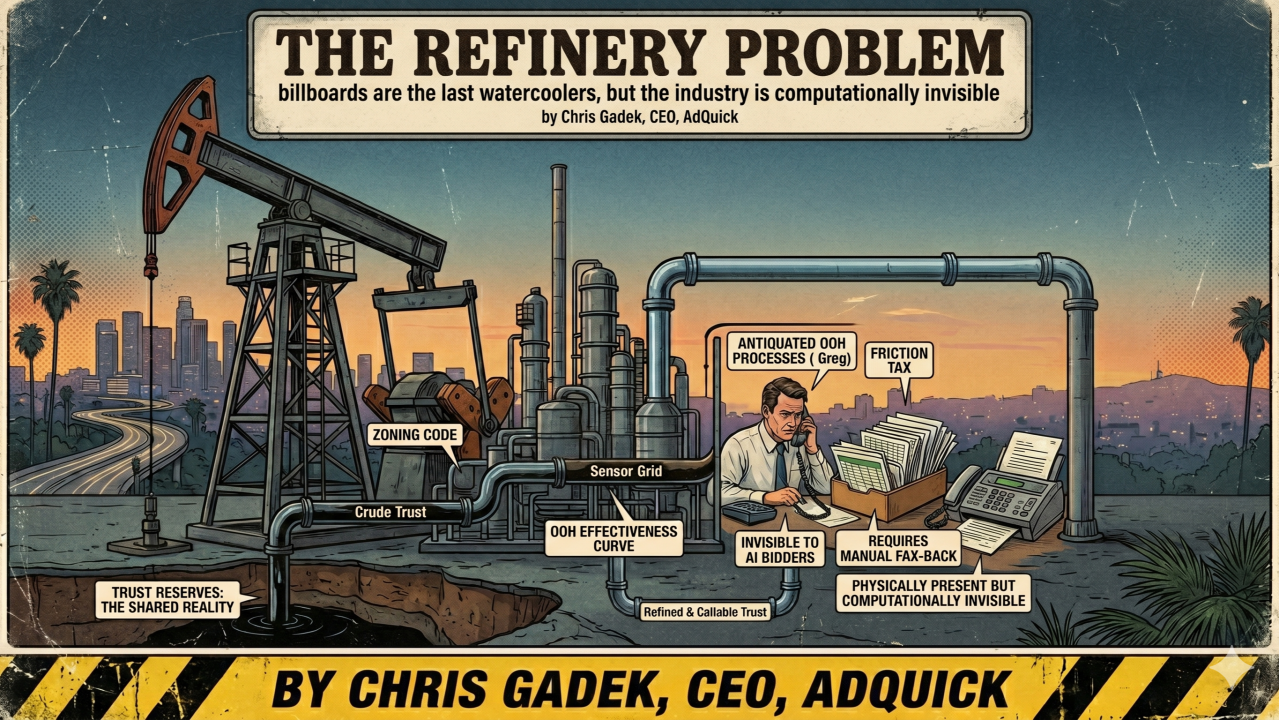
Nick Brien told the world's out-of-home executives that billboards are the last watercoolers on earth. He's right. He handed the industry the diagnosis. The question is whether the industry has built the equipment to act on it.
---
I have a theory about watercoolers that I've never been able to prove, which is the best kind of theory because it can't be ruined by evidence.
The theory is that the watercooler was never about water. The office watercooler, the literal appliance, existed for maybe seventy years as the agreed-upon location where people who had all consumed the same television the night before could confirm that they had, in fact, all consumed the same television the night before. It was a verification machine. You watched the same broadcast I watched, the same finale, the same channel out of the same three, and the next morning we stood next to a humming metal box and ratified the experience into something real by saying it out loud to each other. The water was incidental. The shared reality was the product.
We don't have that anymore, and everyone knows we don't have it, and the standard explanation is "fragmentation," which is true and also the kind of word people use when they'd rather not say anything. The more interesting thing is what fragmentation did to trust. When everyone watched the same three channels, you didn't have to trust the channel, because you could verify it against your neighbor. The neighbor was the fact-check. Now there is no neighbor. There is an algorithm that has built you a private channel of one, tuned so precisely to your preferences that no other human being on earth is watching exactly what you're watching, which means there is nobody left to confirm that any of it is real. We solved loneliness by giving everyone their own personal reality, which is a bit like solving thirst by handing everyone a separate ocean.
I bring this up because Nick Brien recently stood in front of the World Out of Home Congress and used almost the same phrase. He called billboards the last watercoolers on earth. He is the CEO of Outfront, he comes from the buy side rather than the sell side, and he has the specific authority of a man describing an industry he chose on purpose, with the clear eyes of someone who arrived as a believer rather than an inheritor. I want to take his argument seriously, which means I'm going to agree with about ninety percent of it and then spend the rest of this telling you why the last ten percent is the only part that pays the rent.
---
Brien's thesis, compressed: data was supposed to be the new oil, but the thing that actually turns out to be scarce and valuable is trust, and trust is the one resource the digital advertising economy has been strip-mining for twenty years without bothering to replant a single tree.
He has the numbers, and they are not shy. He cites Mark Pritchard, who ran brand at Procter & Gamble for four decades and chaired the Association of National Advertisers, whose single largest grievance with the digital ecosystem is trust. He cites surveys showing trust in digital ads falling year over year, and trust in American mass media sitting at its lowest point in fifty-four years. Seventy percent of global ad dollars now flow to digital, three-quarters of that consolidated among four companies, and the walls those companies built keep getting higher while the thing inside the walls keeps getting cheaper and weirder. The Goliaths are winning the war and quietly losing the reason anyone signed up to fight it.
I find this persuasive the way I find a good documentary about a collapsing fishery persuasive. The data is real, the trend line is real, and the conclusion feels both correct and a little too tidy. Because here's the inconvenient thing about declaring trust the new oil: oil was never worth anything sitting in the ground. Oil got valuable because somebody built the entire bloody apparatus to drill it, refine it, and pipe it somewhere it could burn. A trillion barrels under the desert is worth precisely nothing until there's a refinery. Trust, as a warm feeling people have about a medium, is the crude. The question Brien opens, the one I think is the most important in the whole talk, is whether out-of-home has built the refinery, or whether it's standing proudly on top of the richest reserve in advertising with no idea how to get it out of the ground.
---
The part of the talk that's genuinely important, the part worth the conference badge, is the agentic turn.
It goes like this. Within eighteen months, every consumer has a personal AI agent. The agent handles the preferences that aren't really preferences, the joyless ones: the paper towels, the phone plan, the flight that's somehow cheapest at 6:05 on a Tuesday. You keep the few categories you actually care about (Brien's example is fine wine, mine would be vinyl reissues of records I already own on CD, which tells you everything you need to know about me) and you hand the rest to a system that searches, negotiates, buys, and ships while you do absolutely nothing. Consumers don't trust this machine yet: large majorities distrust AI search results, fret about their data, and don't believe the shopping recommendations. And OpenAI is projecting a hundred billion dollars in ad revenue by 2030, which is the number you drop when you want a room full of people to feel a very specific kind of dread.
Right diagnosis. Brien frames it as a trust problem, which it is. I'd add that it's also an architecture problem, and that second framing is the one I want to sit with, because it's where the whole ballgame gets decided.
Here's what happens when your agent does your shopping. The agent filters your email, so email marketing now performs for a robot. The agent browses the web for you, so the display ad renders to a piece of software that has no eyes and cannot be charmed. The agent watches the video and hands you the summary, so the pre-roll plays to an empty room. Every digital channel that currently ends in a human being is about to end in an agent instead, and agents are immune to advertising the way a calculator is immune to a good story. You cannot make a spreadsheet feel anything. People have tried. It does not feel.
So when Brien says billboards are the last watercoolers, the deep version of that isn't nostalgia. It's structural. Out-of-home is the one channel that reaches a human without first asking an agent's permission. Your assistant can decline your emails and skip your pre-roll and blend your feed into a smooth gray paste, but it cannot close your eyes while you're sitting on the 405 at four-forty on a Thursday wishing you were anyone else. The thing that made billboards look primitive for thirty years, that you can't click them, can't pixel them, can't optimize them between heartbeats, is about to become the only reason they're left standing. Physical attention turns scarce precisely because it's the one kind you can't automate out of the room.
---
Brien's next move is the one I'd have stolen if I'd gotten to the podium first: the shift from the attention economy to what he calls the action economy.
The attention economy, the water we all grew up swimming in, defined winning as capturing eyeballs, maxing out screen time, selling impressions by the truckload. Brien says the marketers he talks to, the ones steering ten-billion-dollar budgets, don't want any of that anymore. They want participation, discovery, outcomes. They want action. And the people who already cracked the action economy aren't in advertising at all. They're the creators, and the creator economy is roughly four times the size of all American out-of-home, which should sting, because the creators are selling the exact thing out-of-home has been giving away free for a century.
That thing is trust plus reach plus authenticity. Brien points at Ronaldo, the first billionaire athlete, a billion followers, who treats fans like people instead of like cohorts. And I'd push the example further than he does, because Ronaldo isn't trusted on account of some mystical authenticity. He's trusted because he's legible. You can see him. He stands in stadiums full of actual bodies and exists as a continuous public object instead of a feed item that evaporates the second you scroll. He is, in the most literal sense available, out-of-home. The creators didn't invent a new kind of trust. They dusted off the oldest kind there is, the trust you extend to a thing that is undeniably there, slapped a price tag on it, and sold it back to brands while the medium that has been manufacturing that exact feeling since the Pharaohs stood around wondering why nobody respects it.
---
So Brien gets to what he calls the real challenge, and here he's braver than most people in his chair would dare to be. The industry's problem, he says, is not measurement. The problem is marketing.
This is heresy in a room full of OOH executives, because measurement is the anxiety everyone has agreed to share. It's the safe one. If the problem is measurement, the solution is a better panel, a cleaner currency, a more defensible decimal point, and you get to spend another decade in a conference room arguing about methodology while the brief gets written without you. Brien's point is that the medium has spent years apologizing for being physical, chasing digital, contorting itself into a worse version of the thing trying to eat it, when its actual job is to convince the world it's something digital can never be.
And the maddening part is the effectiveness was never in question. A Nielsen study for the OAAA found that the online activations out-of-home kicks off, the searches and the social chatter that follow somebody clocking a billboard, index at more than three times the rate you'd predict from its slice of ad spend, leaving television, radio, and print in the dust. The medium is already swinging at triple its weight class. It is, by the numbers, the most efficient line in the plan and the first one anybody crosses out under deadline. That is not a measurement gap. That's a marketing gap, exactly as Brien says, and no panel ever built is going to close it.
His prescription is a rebrand: stop saying out-of-home, start saying in real life. The only medium built to serve citizen consumers, the one that owns the seventeen hours a day people spend not staring at a personal screen, the hours they're commuting and traveling and shopping and standing shoulder to shoulder in a crowd. He runs the proof points like a man who enjoyed assembling them, and frankly so would I. Gucci taking Times Square as a shared event instead of a private one. Louis Vuitton spending five years building a Fifth Avenue store as a thing to be photographed. Apple putting Alicia Keys in Grand Central for its fiftieth and using all of New York as a canvas. British Airways wrapping a shuttle between Times Square and Grand Central with real flight attendants handing scones to commuters, which sounds unhinged right up until you notice it bought more genuine affection than a hundred million programmatic impressions ever did.
None of those were ads the way a banner is an ad. They were physical events that happened to wear a logo, and the trust came from the fact that they stood in real space in front of real people who couldn't quite tell whether they were being marketed to or simply living in a city where something good was happening. That ambiguity is the product. Try replicating it in a feed. I'll wait.
---
And here is where the crude finally turns into something you can put on an invoice, because for once the warm feeling has a hard number sitting underneath it. A 2024 study the OAAA ran with the Harris Poll said it about as bluntly as research ever permits itself: 73% of people view digital out-of-home favorably, against 50% for television and 48% for social. That is not a rounding error. That is a different tax bracket of regard. And it converts, which is the part that should keep the holding companies up at night: 93% of people who walked into a store after seeing a directional out-of-home ad actually bought something. The medium people trust the most is also the medium that moves them the most, and the market is pricing it as though neither of those facts were true.
That is the refinery problem in one sentence. The reserve is enormous and confirmed. The crude is top grade. The only thing missing is the equipment that turns it into something the rest of the industry can actually run on.
Then Brien lays out his rules for the new world, and I'll hand them over straight because they're good and they don't need my fingerprints. Stop selling impressions; predict intent. Stop targeting audiences; optimize for outcomes. Stop measuring attention; measure action. Stop planning by hand; lean all the way into agentic AI and build the end-to-end systems the holding companies are already quietly building. Stop leveraging reach; champion trust.
He even fed eight quarters of earnings calls to an AI to see who's talking about what, and found out-of-home still muttering about audience proxies while Alphabet, Meta, and Amazon talk prediction and outcomes. The medium is fighting the last war with the last war's dictionary, and by the time it perfects the audience measurement it's been agonizing over, everyone else will have wandered off to a question it never learned to spell.
And here's what people get wrong about that list. They assume the creative side can't keep up. It can. It already does, embarrassingly well. When PODS and the agency Tombras pointed Google's Gemini at a campaign last year, the thing spat out more than six thousand hyperlocal billboard headlines in twenty-nine hours and drove a sixty percent lift in site visits. Over half of out-of-home marketers already use AI in some form. The imagination caught up a while ago. The pixels can change faster than a person can type. That was never the bottleneck.
The bottleneck is the part nobody on that stage quite said out loud, and every one of Brien's rules trips face-first over it. Predict intent. Optimize outcomes. Measure action. Plan agentically. Every one of those verbs needs the medium to be callable. Not buyable the way out-of-home is buyable today, which is to say via a phone call, an emailed availability spreadsheet, and three weeks of reconciliation that age you visibly. Callable the way digital is callable. Queryable in real time, structured, machine-readable, the sort of thing an agent can talk to without a human standing in the middle translating.
Because if the future Brien describes is real, if media plans get assembled by systems instead of people, the planning agent does not care how trusted your medium is in the abstract. It cares whether it can reach you. It will build the omnichannel campaign by calling the digital channels, because they answer on the first ring, and it will skip out-of-home, because out-of-home answers in fourteen business days through a man named Greg. Agents don't pick up phones. They don't negotiate over email. They certainly don't wait for Greg. The most trusted medium on earth, the one converting at ninety-three percent and punching at triple its weight, is about to go completely invisible to the exact systems deciding where the money lands. Not because it lost the trust. Because it can't take the call.
That's the gap. Brien is right that the answer is in real life. Right that trust is the fuel, that the action economy is the field, that the watercooler is the metaphor. What the talk leaves on the table, maybe because it wasn't his to say, is that none of it ships unless somebody builds the layer that lets the physical world answer when the machine rings. The trust is in the ground. The crude is the best on earth. The refinery is the thing nobody on that stage was selling.
That layer is what we've spent the last several years building at AdQuick.
I know exactly how that reads after three thousand words of nodding along to another man's speech, so let me be precise, because I am not handing you a slogan. The reason out-of-home gets cut the second anyone's under deadline has never been that billboards don't work. The Harris Poll UK, A Stagwell Company and the Nielsen index say flatly that they work better than almost anything else in the room. It's that buying them is a special kind of misery that compounds. The gap between out-of-home's share of human attention and its share of the budget is, almost entirely, a friction tax. We've been in the business of abolishing that tax: pulling hundreds of thousands of placements, the audience data, the pricing, the measurement, into one place that can be planned, bought, and proven the way a buyer expects everything else on earth to behave.
The agentic part is the same project aimed straight at the future Brien sketched. We're building the platform so an AI agent assembling a campaign can actually operate it, see the inventory, query it, plan against it, and book it, without a human playing interpreter between the agent and the wall. So that when the planning machine reaches for out-of-home, the medium picks up. The thing that has been standing here since the Pharaohs, the last channel that reaches a person without an algorithm posted at the door, finally becomes legible to the systems about to control the spend.
Brien's right that billboards are the last watercoolers. I'd only add the part he left for the rest of us. A watercooler nobody can find isn't a gathering place. It's a humming box in an empty hallway, full of the most trusted water on the planet, that no one will ever drink because there's no map to the room.
We're drawing the map.