
Avoid These 3 Outdoor Advertising Campaign Pitfalls

In the marketing world, what was once considered “old” is now new again.
Take outdoor advertising, also known as out of home (“OOH”), as an example. With the evolution of digital media to a company’s branding mix, companies have moved their budgets and advertising interests to campaigns that they can model, seemingly, with clickthrough, engagement, and online conversion data.
That’s why digital marketing, as a share of total marketing budget, has slowly been moving from offline to online channels.
According to one forecast from eMarketer, 2019 will be the first year online ad spending is higher than print and TV spend. By 2023, according to the same study, digital ads will capture two-thirds of all ad dollars.
As the digital advertising market continues to grow; however, so does the potential for media waste. On crowded ad networks, where audiences compete for weakening attention spans, placements depend on basic rules of supply and demand—costs per click (CPCs) depend on the ecosystem as a whole.
Since 2013, brands have been competing at a higher cost for the same amount of impressions. That trend doesn’t account for resource drains that happen behind the scenes related to click fraud and brand trust.

Even with sophisticated tracking capabilities and attribution models, digital media may not be delivering the ROI that marketers think they’re getting.
That’s why out of home is becoming popular again, with some of the lowest average CPM costs nationwide (around a $4 CPM nationally).
But marketers still view this terrain as the wild west—only three percent of U.S. ad spend goes to outdoor advertising, even though consumers spend 70% of their time outside, according to the Out of Home Advertising Association (OAAA).
Smart marketers will look at this gap in the market as a window of opportunity.
Outdoor advertising has the potential to be more effective than channels like search, social, and display, where audiences aren’t likely to be paying attention, anyway.
But windows of opportunity have the potential to be risky if you’re not sure where you’re leaping. How can you make sure that your audiences are looking at your ads?
The key to success is avoiding potential problems before they have a chance to happen.
Here are some potential pitfalls that could get in the way of an otherwise-successful out of home strategy.
Ignoring OOH’s digital-first value proposition
The lines between consumers’ online and offline identities are blurring. Especially with the rising adoption of mobile phones, globally, every human is reachable through a unique identifier.
“To be fair, out of home isn’t really out of home anymore,” explains Ken Suzuki, digital marketing director at technology company 8X8.
Suzuki, an AdQuick customer, uses AdQuick to run billboard campaigns in major metropolitan areas across the United States, to build awareness for its telecommunications software.
Overseeing tens of millions of dollars in advertising budget, Suzuki explains that he buys out of home to gain efficiencies across his multi-channel, multi-touch marketing campaigns.
“The success of our campaigns depends on measurability. Marketers think of digital media as intuitive, targeted, and rich. But there’s a lot of media and revenue waste, as well as a lack of predictability. But a billboard is always going to be there. Any platform has the potential to be accessible through a digital partner—potentially programmatically.”
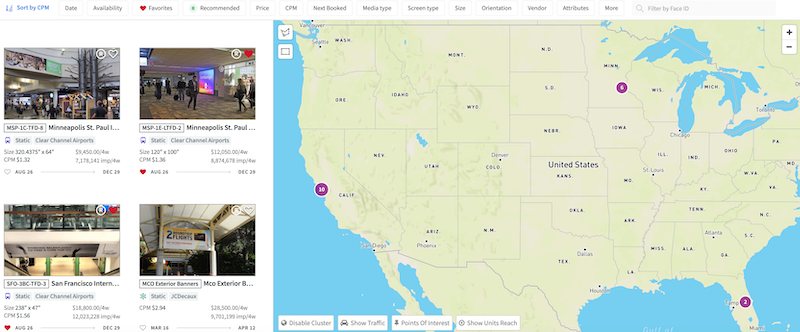
Whether you’re running a campaign on a digital or static billboard—or any other ad unit, for that matter—you can consider out of home to be an extension of your core digital strategy.
That means, you can compare the performance of an outdoor ad to channels like mobile, video, search, and social media.
Thanks to mobile phones, it’s possible to create attribution models that connect offline channels with the digital world.
Out of home extends the reach and precision of digital media into the real world. As a result, companies can create a more accurate and precise lifetime value model.
AdQuick has also made it possible to track performance data based on geofencing capabilities, mobile analytics, and social media shares. Many AdQuick customers also run brand lift studies to assess whether marketing campaigns became more efficient, overall.

Remember—every collection of data points tells a big-picture story
Buying Media Directly
One of the biggest barriers to buying media is accessibility. You may know you want to buy a billboard unit, but you may not know how to reach media. Or what happens if you want to purchase a batch of billboards in multiple cities?
There are thousands of media owners throughout the country. For example, California has over 175 media owners, New York over 115, and Illinois has almost 100 media owners.
The process of building a campaign, especially if you aren’t on-the-ground in market, can be arduous.
Unless you’re an expert with a background in the out of home industry—or have the budget to work with a large agency—you may need to spend a few months navigating the learning curve.
For many media buyers, the lack of transparency into the out of home market is a barrier to getting started with this channel, in the first place.
That’s why, despite the benefits of reaching consumers in their physical worlds, out of home has been out of reach to budget-constrained marketers.

But this picture has the potential to change with the rise of marketplace-style third parties that are bringing new, technical capabilities to billboards, train stations, bus stops, elevators, taxi cabs, and other digital environments.
That’s why, unlike most other business models, it’s often less expensive to work with a third-party platform than with the media owner, directly. You can cut the time you spend sourcing inventory and planning a campaign.
“With AdQuick, you can deploy a campaign across multiple media owners with a single point of contact,” explains Daniel Mori, former VP of marketing at Ethos, which is a startup that simplifies the life insurance purchasing process for consumers.
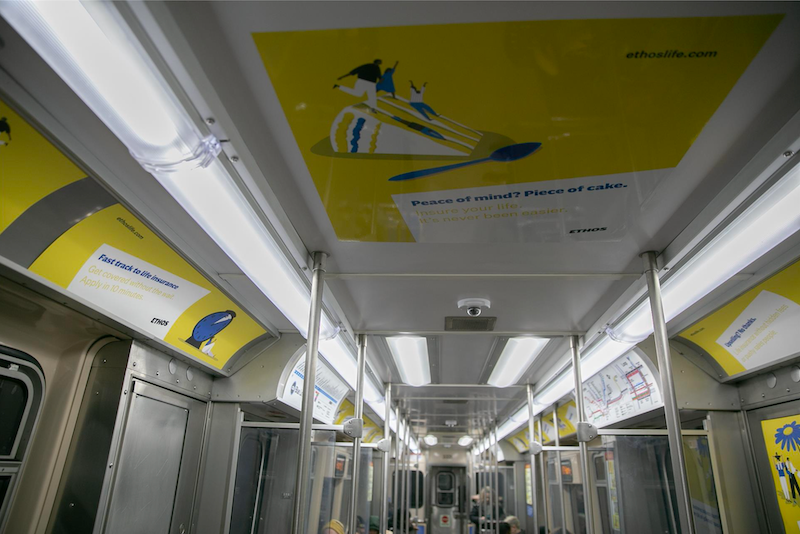
Without AdQuick, out of home was out of reach to a company like Ethos, which is a company in its early stages.
“We’re always in a rush,” Mori explains. “Our ability to move fast helps us learn more. The AdQuick platform makes it possible to deploy a campaign across multiple media owners, with a single point of contact. We could customize placements, targets, and budgets—everything. We had a specific budget in mind, which we could have used in a number of ways. Because AdQuick isn’t a single vendor trying to manage the yield of very specific placements, their team was able to help us find multiple options in multiple geographies.”
Buying media directly has the potential to skew your birds eye view—and your campaign’s performance, as a result.
As a marketer, you gain an advantage when you see your entire audience acquisition landscape rather than a small part of it.
“Our hypothesis was that out of home would improve the efficiency of the top of our funnel—which would make our funnel more efficient, overall,” says Mori.
Ignoring the context of your OOH campaign
How do you run a campaign in a city where you’ve never been?
Should you advertise on a bench, bus stop, billboard, taxi, train station—or something else entirely?
How can you be confident that your campaign will be successful in-the-moment?
These questions can be tough to answer, especially if you don’t have experience in the geography where you’re purchasing media. Without insight into how audiences are “seeing” your ads, you risk wasting resources.
What happens if your valued placement ends up behind a construction site, accidentally? How do you know if your audiences are engaging with your ad or simply walking by without looking at their surroundings? How do you advertise in a neighborhood, city, or state that you haven’t personally visited?
Your strategy, in this situation, is to think like a researcher. Look at pictures of potential billboard spots. Take a look at a campaign’s surroundings. Put yourself in the shoes of people who are on the receiving end of your messaging.

Are they likely to pay attention?
Would you pay attention if you were a person in your audience?
Look at the data that describes the people you’re reaching. What are people likely to be thinking when walking past your ad? What do they care about most in their lives?
“Awareness-based advertising works best and is most effective when it inspires a connection,” explains Suzuki. “Knowing your audience—so you can develop the right messaging—is key at this point.”
The way to make a connection is to imagine yourself in someone else’s shoes.